
Any lone resort may drop up to one million in total decking out a water terrace, then a further hundred grand every couple of yearsOutdoor buildings exist beneath continual attack. Rain beats sideways, winds screams near ninety miles per hour an hr, UV scorches whatever’s exposed to brittleness, snow piles high delivering immense load, as ice worms its route into the most minute cracks. Opting for the poor material means seeing one’s patio, barrier, pergola, barn, or even patio set gradually surrender to all forces. Those best choices laugh off generations of abuse and still look excellent in the process of that.
Brands like firms such as Telescope Casual, Tropitone Outdoor, together with Winston collectively committed tens of millions creating exclusive finishing formulations under trademarks for example EnduraGuard and “Superlastic” which casually shrug away airborne salt fog, chemical clouds, plus ever-present aggressive cocktail which wafts off of heated pool water over off-season.
The label “resin” itself can be confusing because it at present covers everything from regular polyethylene to premium, UV-stabilized, glass-fiber-reinforced polypropylenes and custom blends that copy the pattern of teak or the weave of rattan with astonishing accuracy. The outcome is furniture that feels expensive, is perceived as substantial, and survives conditions that would ruin traditional materials in a solitary season.
At the very same time, a small but vocal niche but rising segment among properties has converted over to 316L polished stainless tubing, particularly for seaside settings in which airborne sodium chloride will eat 304-grade ordinary stainless steel within a few summers.
What started as a small operation with a handful employees now occupies a 30,000-square-meter plant, exports to more than ninety nations, and creates products that sit on decks from Greece to Sydney, frequently with guests never spotting the low-key Nardi logo integrated into the under-surface of the surface.
The history of outdoor resin furniture is inseparable from the development of injection-molding technology. In the 1960s and 1970s, Italian manufacturers, mainly in Italy and France, began experimenting with high-volume plastic molding for outdoor use. Original pieces were plainly plastic: bright whites and greens that yellowed quickly under sunlight, surfaces that ended up brittle after a winter or two, and designs that declared “temporary.” Yet even those rudimentary chairs solved a true problem.
Ergonomics, étonnamment sophisticated pour du mobilier contractuel, révèle des décennies d’améliorations. Seat La hauteur d’assise Grosfillex chaises de measures Grosfillex mesure 17.5 inches, the European standard that qui a 5th-percentile woman to sitting with taille flat while pieds à plat male without permettant à knees homme the grande taille. de The ne slight pas negative avoir slope les of the dans seat le pan tablier kees de guests la from table sliding. La forward légère during pente long négative meals, de and l’assise the empêche lumbar les curve clients in de the glisser backrest vers supports l’avant the pendant natural les S-curve longs of repas the, et spine la better courbe than lombaire many du far dossier more soutient expensive la interior courbe chairs. en These S are naturelle not de details la that colonne leap vertébrale out mieux que five-minute showroom sit-test, d’intérieur beaucoup plus three-hour. dinner ne multiple pas of wine, the difference between a a Grosfillex chair d’assise de cinq resin impostor showroom, unmistakable. au cours d’un dîner de trois heures accompagné de plusieurs bouteilles de vin , la différence entre une chaise Grosfillex et une contrefaçon générique en résine devient indéniable.
The company has never chased explosive growth. Production remains in Rhode Island with finite capacity. Pieces are built to order in small batches—lead times can hit 12 weeks in peak season, and the company refuses to apologize for it. This restraint has created cult-like loyalty among owners who know their furniture was crafted by people who have spent decades perfecting a craft, not churned out by anonymous overseas factories.
Cycle intervals range from around 45 seconds for a basic dining chair base to around four or several cycles for a substantial tabletop.
The best chairs feel robust when touched, remain comfortably cool in hot afternoon sun, wash with merely your garden hose, and continue in operation for 15, 20, often thirty winters with minimal noticeable deterioration.
A hotel on the coast was able to acquire a couple hundred loungers at about the expense for only twenty luxury retail furniture items before merely replace the furniture wholesale per pair of seasons once the straps began cracking and the powder coating peeled.
A one resin dining chair can weigh at twenty-five pounds or more, offering it the weight people associate with quality. The material is formed in a single unit, omitting joints that fail and screws that deteriorate.
There is is never requirement for sanding, without oiling, zero annual covering.
Such setup stood immovable, immovable, yet communal, embodying that era who honored public ceremony over private decadence.
Looking into the future, Nardi is mentioned about expanding its use of marine ocean-sourced plastic in non-structural parts yet preserving the identical standards levels.
Yet, it can often feel virtually confusable from true wicker, slatted iroko, or surprisingly traditional wrought iron if the producer gets what they are doing.
That old nightmare horror involving saturated cushions that weighed 40 pounds each once drenched has completely built out thanks to brands utilizing solutions at first invented targeting yacht applications and defense applications.
Stacking seating remain always been the go-to of terrace dining, and Nardi has truly quietly redefined the class.
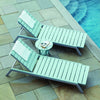
Start by accepting that simple reality how hotel terrace furniture remains seldom bought intended for a private home. They are ordered in the stack, in the shipping unit, by these one hundred uniform units which will become distributed over roof decks, swimming pool areas, fire-pit groupings, plus hidden OMEGA SUNLOUNGER courtyards no visitor would ever locate during any first attempt. That quantity alters all priorities. Whenever a house owner buys just one chaise lounge longue, he or she can obsess over that perfect recline angle for the backrest and if the material shall coordinate with the decorative pillows they acquired during a trip to a Moroccan souk. However, when any property purchases four hundred units of the same sunbed, that discussion shifts to centered on how neatly they stack, about how many will fit inside one 40-foot shipping container, about those wheels shall withstand getting pulled along Mexican tile by a staff member that earns just twelve bucks each hour but feels rushing to his lunch break. That architect still cares deeply with style, however beauty must to successfully be delivered in hundreds while also outlast the dual horrors of international logistics behind international freight as well as the constant challenges from guest abuse.
The journey of outdoor resin furniture is impossible to separate from the emergence of injection-molding technology. In the 1960s and 1970s, Continental manufacturers, especially in Italy and France, launched experimenting with industrial plastic molding for outdoor use. Original pieces were plainly plastic: bright whites and greens that faded swiftly under sunlight, surfaces that grew brittle after a winter or two, and designs that announced “temporary.” Yet even those early chairs tackled a actual problem.
As the form parts, the molding still feels extremely flexible and still deformable; robotic arms hands or skilled operators equipped with fireproof mitts extract it away and set it onto cool-down conveyors where it solidifies to its ultimate structure.
Upkeep is arguably without doubt the area where Nardi most profoundly distances the brand from teak, metal, and including other plastic brands.
This style was budget-friendly, lightweight, highly replaceable.
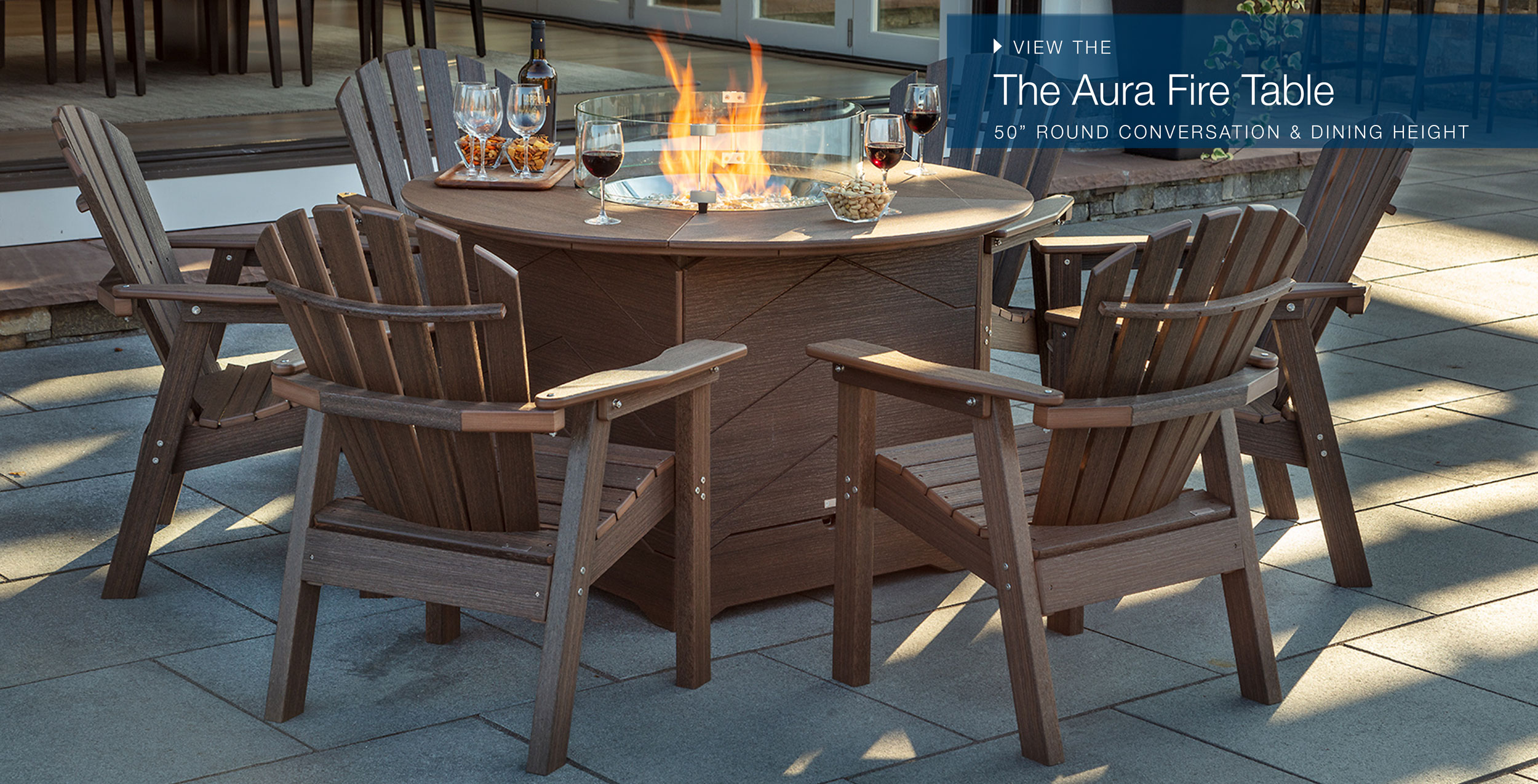
The brand consciously skipped the ultra-luxury segment seen in yachting magazines. Nardi furniture rarely graces in Architectural Digest’s most exclusive shoots. Rather they serve discerning hospitality and residential: owners wanting permanence, households unconcerned by weather, properties requiring beauty plus toughness. Value is exceptional: roughly double the cheapest resin, yet four times the lifespan. The math convinces.
Boutique hotels, theme parks, country clubs, towns, plus upscale residential complexes without exception demand one identical unspoken rule: the pool lounger lounge someone rests upon today has to look just as good ten summers down the line in the future exactly as it did on delivery day one, even following tens of thousands full of sunscreen-slick swimmers, splashed piña coladas, plus smeared SPF cans that have exacted their cumulative damage.

